301 Moved Permanently
Drone Emerges As Quality Control Tool For Solar Developer
Solar and wind project developer BQ Energy is adopting unmanned aerial vehicle (UAV) technology as a new method of quality control.
The Poughkeepsie, N.Y.-based firm, which sites projects mostly on brownfields and landfills, collects aerial images or video of a solar project in order to assess the scene at a different view from that of ground-based photography.
“It offers a unique perspective to what we do,” says Paul Curran, managing director of the firm. “In the solar world, you really want to check everything as carefully as you can.”
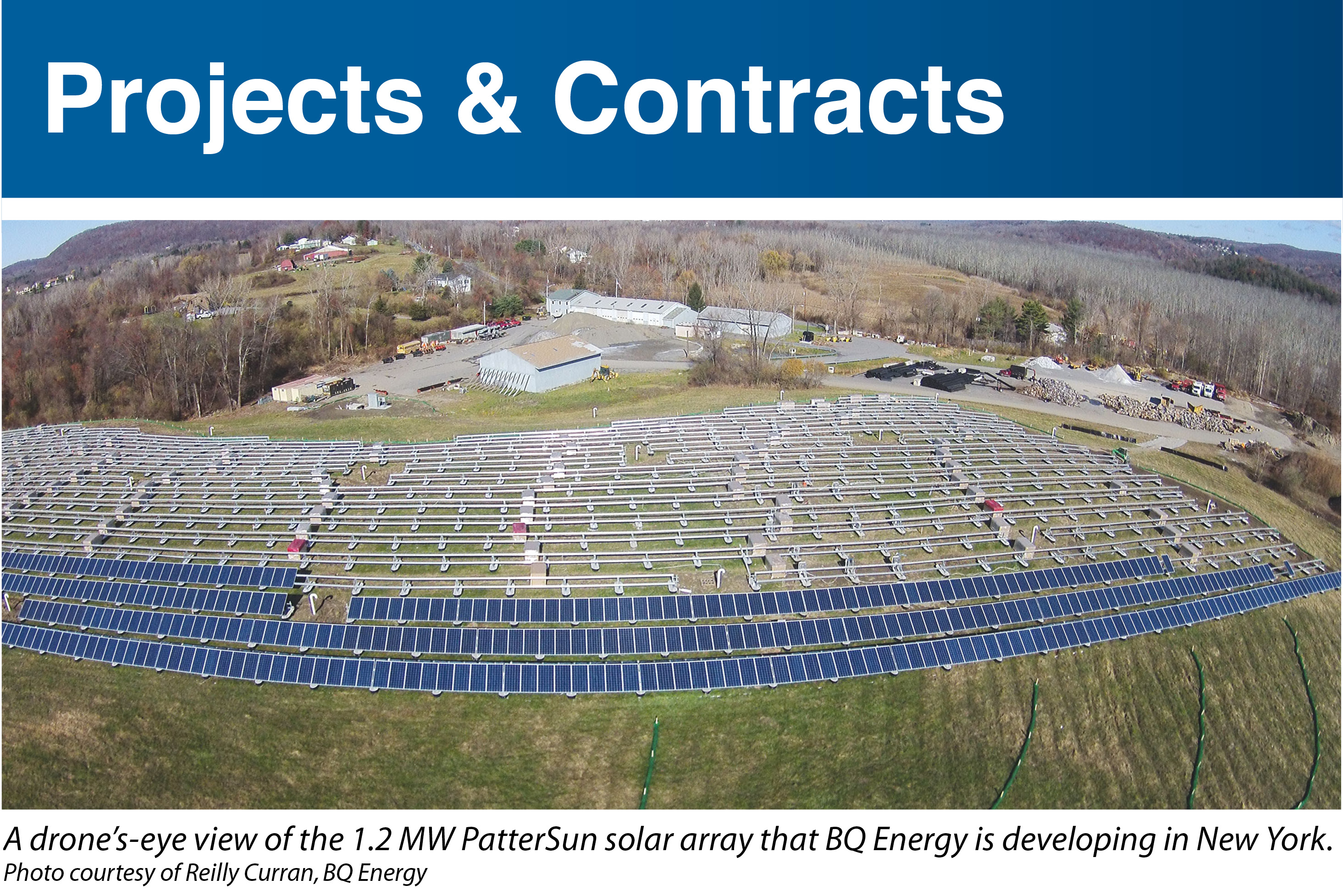
Curran says checking the quality of a racking system, for example, is more limited from the ground. By using a UAV at a height of around 100-200 feet, BQ Energy can see a broad, overhead view to make sure the entire system is straight and in proper alignment before the next steps take place (e.g., pouring concrete, placing wires, installing the panels).
“It’s a good way to have quality control at an early stage of the process,” Curran says.
To do the job, BQ Energy has hired a trained operator, who flies the company-owned DJI Phantom 2. The company also uses the aircraft to monitor a solar project’s stages of construction - from a blank site to the finished product.
In lieu of sending a group of engineers to review a location, the operator and his aircraft may travel to a potential development site to conduct a photo reconnaissance by drone. Curran says the company can often get the job done with only one person this way.
The same method applies for a project under construction: The company will send out the operator a few times a week to take photos and video of a site. According to Curran, the company saves time by not having to send a crew to a construction site every day. The drone video, he says, “allows us to get a very good look at it and talk about it.”
And when a project is complete, he adds, the company occasionally uses the UAV at a height of 300-350 feet to capture the entire project. As shared by solar racking systems provider GameChange Racking, BQ Energy used the drone to take a video of GameChange’s Pour-in-Place ballasted ground system installed for the 1.2 MW PatterSun solar array it is developing on a landfield site in Patterson, N.Y.
Because the firm deals with brownfields and landfills, looking at terrain is a priority when it develops a site. In comparison to Google Earth, for instance, a drone offers more details.
“It really does give you a lot more perspective than Google Earth can,” Curran says. “Google Earth is great, but this really helps quite a bit.”
Abengoa To Go It Alone On Palen CSP
Spain-based Abengoa has agreed to acquire BrightSource Energy’s interest in the Palen Solar Energy Generating Station (PSEGS) project in California.
Upon finalization of the purchase transaction, Abengoa will become the sole developer of the concentrating solar power (CSP) project. Abengoa says it will continue to pursue a tower-based design for the plant, but will propose its molten salt tower technology, incorporating large thermal energy storage (TES) capacity. Details of the transaction have not been disclosed.
In September, the California Energy Commission (CEC) recommended that a one-tower configuration for the PSEGS project be approved. This had been a revision from an earlier two-tower configuration. Because Abengoa has now assessed that the TES capability for Palen is best accomplished in a two-tower configuration, a new revision application must be submitted to the CEC.
Abengoa says TES allows solar energy to be stored so that it can be dispatched when the sun is not shining, provide peaking or even baseload power. Abengoa is using similar technology for its 110 MW Cerro Dominador CSP tower project in Chile. A variation on TES was used for the Solana parabolic trough CSP plant Abengoa built for Arizona Public Service Corp.
Schneider Supplying
300 MW French Project
A consortium consisting of Eiffage, Schneider Electric and Krinner has been awarded a contract for the construction of a 300 MW solar farm and an extra-high voltage substation in Cestas, France.
The consortium will also be responsible for the plant’s operation and maintenance. Work on this project, worth nearly EUR 285 million, is under way.
Eiffage subsidiary Clemessy will perform engineering studies through its RMT business, Eiffage Travaux Publics will provide earth-moving work, and Eiffage Energia will handle the interconnection.
Schneider Electric is providing inverters and transformers. Krinner is providing screw-in foundations and photovoltaic mounting structures.
The project, developed by France-based Neoen, will be connected directly to the very-high voltage power grid and is scheduled to come online in October 2015. It is expected to generate over 350 GWh of electricity per year, which is projected to be equal to the daytime power consumption of the entire population of Bordeaux.
SolarReserve Finishes
Plant In South Africa
SolarReserve has completed the
96 MW Jasper solar photovoltaic power project in South Africa’s Northern Cape province.
The facility is located in a solar park that also includes the 75 MW Lesedi solar power project, which came online in May. It is also the site of the proposed 100 MW Redstone concentrated solar power plant.
As part of the South African Renewable Energy Independent Power Producer Procurement Program, the Jasper project will set aside a percentage of total project revenues for local economic development programs.
With over 325,000 PV modules, the Jasper project is expected to generate about 180 GWh of electricity per year to Eskom, the South African power utility company, under a 20-year power purchase agreement.
The project was developed by a consortium consisting of SolarReserve, the Kensani Group and Intikon Energy. Equity investment and ownership for the project was provided by a group of international and South African shareholders, including the developers.
Stem To Provide 85 MW Of Storage For SCE
Stem Inc. has been awarded
85 MW in the local capacity procurement from Southern California Edison (SCE).
Under the terms of the agreement, Stem will deploy its behind-the-meter energy storage solution at customer locations in the Western Los Angeles Basin to serve as dispatchable capacity for the region.
Stem will begin system deployment following approval from the California Public Utilities Commission.
Stem was previously selected for projects with the Sacramento Municipal Utility District and Hawaiian Electric Co., and is active in the California Independent System Operator wholesale energy market.
TerraForm Acquires
77.6 MW DG Portfolio
TerraForm Power Inc. is acquiring a 77.6 MW distributed generation (DG) solar power portfolio from the Capital Dynamics U.S. Solar Energy Fund LP, a closed-end private equity fund.
The 39 solar power plants in the acquired portfolio are located in California, Massachusetts, New Jersey, New York and Pennsylvania. The portfolio’s power purchase agreements have a weighted average remaining contract life of 19 years.
Upon closing, the transaction is expected to provide approximately $21 million. The transaction is expected to close before the end of the year, subject to regulatory approvals and customary closing conditions. Barclays and JPMorgan acted as exclusive financial advisors to TerraForm Power.
PSE&G Starts 11.18 MW Project On N.J. Landfill
New Jersey-based Public Service Electric and Gas Co. (PSE&G) has started construction on a 11.18 MW solar farm atop the closed Kinsley landfill in New Jersey.
The Kinsley Solar Farm is the company’s third landfill project through its Solar 4 All program. The utility says the project will install 36,841 solar panels on 35 acres of the 140-acre landfill, owned by Kinsley’s Landfill Inc. Conti Enterprises Inc. was selected as the engineering, procurement and construction contractor for the project.
Canadian Solar Building Grid Storage In Ontario
Canadian Solar Solutions Inc. will provide 4 MW, 2.76 MWh of stationary on-grid bulk energy storage to Independent Electricity System Operator (IESO) to support the Ontario grid.
The project was one of 12 selected by IESO in a competitive application process. Canadian Solar will be providing reactive power, voltage support and bulk energy storage services to the IESO using stationary lithium battery technology. Under the contract, Canadian Solar will provide operations and maintenance to IESO for a period of 36 months.
Standard Building
2.1 MW Municipal Array
Standard Solar is deploying a 2.1 MW municipal solar array for Pocomoke City, Md., that will power a wastewater treatment facility.
The 6,150 panel array is expected to produce 2.9 GWh of electricity per year. Electricity produced by the system is expected to reduce the city’s electricity bills by more than $37,000 a year. Additionally, several local nonprofit organizations will participate in the city’s network to reduce their bills by approximately $15,000 annually.
NextEra Starts On Two Projects In Calif.
NextEra Energy Resources LLC has begun the construction of two solar photovoltaic projects on separate sites in Apple Valley, Calif., and Blythe, Calif.
Each site consists of two identical 1.5 MW ground-mounted fixed solar systems with a combined total of approximately 23,000 panels installed.
The projects are part of the California Renewable Energy Small Tariff program, a feed-in tariff program for eligible renewable energy projects under 1.5 MW. Southern California Edison will purchase all of the output from the PV systems under the terms of two 20-year power purchase agreements.
Region Installs 1 MW
Array For Florida Factory
Region Solar has completed a 1 MW solar photovoltaic ground-mounted system at VizCo’s manufacturing facility in Monticello, Fla.
The four-acre array features 3,280 Lightway polycrystalline modules mounted on a galvanized steel racking system designed by S:Flex Inc. The system incorporates 45 SolarEdge 20k string inverters and 1,640 SolarEdge P700 optimizers. The ground cover maintenance is handled by a flock of grazing sheep.
The project is expected to produce over 1 GWh of electricity annually and will be net-metered by Duke Energy.
VizCo produces plastic injection-molded drip pans, alarms and pipe grips for water heaters. Owner Chris Cantolino says he chose solar photovoltaic power to combat small fluctuations in the grid current that created significant losses in the production process of his injection-molded plastics machinery.
Hawaii Air National Guard Gets Solar
Charleston, S.C.-based Hannah Solar Government Services LLC has been awarded a contract by the Hawaii Air National Guard to build an 880 kW solar project at the Joint Base Pearl Harbor-Hickam in Honolulu.
The ground-, roof- and canopy-mounted photovoltaic project is valued at over $6 million. Hannah Solar will serve as the prime contractor. The company says the project will enable it to expand its offices and add staff.
Ross Solar Builds For Connecticut Town
Ross Solar Group has completed five commercial rooftop solar systems for the Town of Stafford, Conn., totaling 660 kW.
The design and installation of the commercial solar power systems was enabled by Connecticut Light & Power’s zero-emission renewable energy credits for small and medium projects. Additionally, Technology Credit Corp. provided the Town of Stafford with a 10-year lease on the solar equipment.
More than 2,000 SunPower solar panels have been installed on the town’s buildings. They are expected to generate an excess of 740 MWh of electricity per year.
Photon Builds Hybrid For Australian Broadcaster
Netherlands-based Photon Energy has built a hybrid solar and energy storage system for Australia-based BAI Group that enables it to operate a broadcast tower 24 hours a day with self-generated electricity. The pilot project received support from the German Energy Agency.
The solar-plus-storage system for the Muswellbrook tower in New South Wales consists of 156 Q Cells Q-PRO G3 255 W solar panels, 72 BAE Secura batteries (supplied by R+J Batteries), three SMA 8.0H Sunny Island inverters, a Photon Energy monitoring system and a diesel back-up generator for emergencies. The PV system has a capacity of 39 kW. The storage system has a capacity of 216 kWh.
Primarily used for local radio broadcasts, the tower facility is also used by local emergency services for communications during bushfires and floods. BAI says it is considering a network-wide rollout of the technology across Australia. R
Projects & Contracts
Drone Emerges As Quality Control Tool For Solar Developer
si body si body i si body bi si body b dept_byline
si depbio
- si bullets
si sh
si subhead
pullquote
si first graph
si sh no rule
si last graph